AI-Powered Insights in Modern Accounting Software: Transforming Financial Reporting and Decision-Making
ATES POST: The accounting industry has undergone a dramatic transformation in recent years. What was once dominated by static spreadsheets and backward-looking financial reports has evolved into a dynamic, intelligent ecosystem driven by real-time data, automation, and AI-powered insights. Today’s accounting software no longer just records transactions—it actively helps businesses predict trends, uncover risks, and make smarter financial decisions faster than ever before.
As organizations face increasing complexity, tighter regulations, and the need for agility, AI-powered insights have emerged as a critical differentiator in modern accounting systems. This article explores how next-generation reporting features are reshaping accounting, the role of artificial intelligence in delivering actionable insights, and why clean data, integration, and security are essential to unlocking the full potential of these technologies.
The Evolution of Accounting Reporting: From Static to Smart
Traditional accounting reports were largely historical. Monthly balance sheets, income statements, and cash flow reports provided a snapshot of past performance but offered little guidance for future decisions. By the time reports were generated and reviewed, the data was often already outdated.
Modern accounting software has shifted away from this reactive model. Cloud-based platforms now offer real-time dashboards, automated reporting, and continuous data updates. These advancements allow finance teams and business leaders to monitor performance as it happens rather than weeks after the fact.
However, the true breakthrough lies in the integration of artificial intelligence. Instead of simply presenting data, systems now analyze it—transforming raw numbers into AI-powered insights that support proactive and strategic decision-making.
What Are AI-Powered Insights in Accounting?
AI-powered insights refer to the use of artificial intelligence, machine learning, and advanced analytics to interpret financial data, identify patterns, and generate recommendations. Rather than relying solely on human analysis, accounting software can now:
- Detect anomalies and potential errors automatically
- Forecast revenue, expenses, and cash flow
- Identify inefficiencies and cost-saving opportunities
- Highlight risks related to compliance or liquidity
- Offer predictive scenarios based on historical and real-time data
These insights are delivered through intuitive dashboards, alerts, and visualizations, making complex financial intelligence accessible to both finance professionals and non-financial stakeholders.
Real-Time Dashboards: The Foundation of Intelligent Reporting
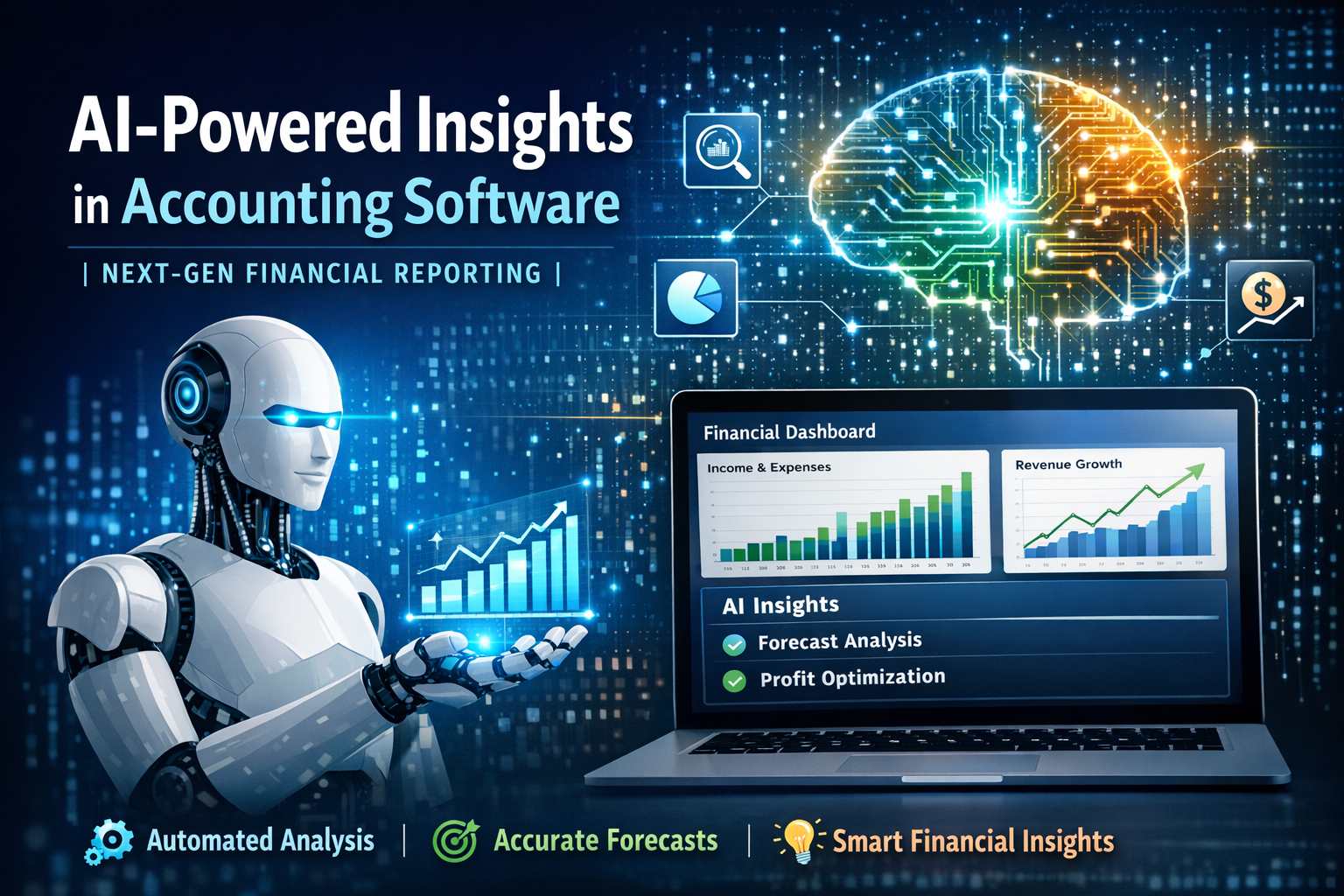
Real-time dashboards are the backbone of next-generation accounting software. They consolidate financial data from multiple sources—general ledger, accounts payable, accounts receivable, payroll, and even external systems—into a single, unified view.
With AI layered on top, dashboards go beyond basic metrics. They can surface trends that might otherwise go unnoticed, such as gradual margin erosion or unusual spending patterns. AI-powered insights help users understand not just what is happening, but why it’s happening and what to do next.
For example, instead of manually analyzing variances, AI-driven dashboards can automatically flag deviations, explain their causes, and suggest corrective actions.
Predictive Analytics: Looking Beyond the Numbers
One of the most powerful applications of AI in accounting is predictive analytics. By analyzing historical data and identifying patterns, AI models can forecast future outcomes with impressive accuracy.
Predictive capabilities enabled by AI-powered insights include:
- Cash flow forecasting: Anticipate shortages or surpluses before they occur
- Revenue predictions: Model future income based on seasonality and trends
- Expense forecasting: Identify areas where costs may rise unexpectedly
- Risk assessment: Predict the likelihood of late payments or financial instability
These forward-looking insights empower businesses to move from reactive decision-making to anticipatory financial planning.
Automation and AI: Reducing Errors and Improving Accuracy
Manual accounting processes are prone to human error, especially when dealing with large volumes of transactions. AI-powered accounting software automates tasks such as data entry, reconciliation, and classification, significantly reducing mistakes.
More importantly, AI continuously learns from historical corrections and user behavior. Over time, this leads to more accurate categorization and smarter insights. Automated anomaly detection can instantly flag suspicious transactions or inconsistencies, allowing teams to address issues before they escalate.
By minimizing errors and manual workloads, finance teams can focus on strategic analysis rather than routine processing.
The Role of Clean Data in AI-Powered Insights
AI is only as effective as the data it analyzes. Clean, accurate, and well-structured data is essential for generating reliable AI-powered insights.
Poor data quality—such as duplicates, missing fields, or inconsistent formats—can lead to misleading conclusions and flawed forecasts. That’s why modern accounting systems emphasize data validation, standardization, and governance.
Businesses must also ensure that data from different departments and platforms is aligned. When sales, operations, and finance data are integrated correctly, AI can deliver deeper and more meaningful insights that reflect the full financial picture of the organization.
Integration: Connecting the Financial Ecosystem
Next-gen accounting software does not operate in isolation. It integrates seamlessly with ERP systems, CRM platforms, banking APIs, payroll tools, and other business applications.
This integration is crucial for AI-powered insights because it allows AI models to analyze data across the entire organization. For example, combining sales pipeline data with accounting records enables more accurate revenue forecasting and better cash flow management.
The more connected the system, the richer the insights—and the greater the strategic value for decision-makers.
Security and Trust in AI-Driven Accounting
As accounting software becomes more intelligent, it also becomes more data-intensive. Financial data is highly sensitive, making security a top priority.
Modern platforms implement robust encryption, role-based access controls, and compliance with global standards to protect data integrity. Trust is essential for widespread adoption of AI-powered insights, especially when automated recommendations influence high-stakes financial decisions.
Transparent AI models, audit trails, and explainable analytics help build confidence by showing users how insights are generated and why certain recommendations are made.
The Strategic Advantage of AI-Powered Insights
Organizations that adopt AI-powered insights gain a significant competitive advantage. Faster access to accurate, predictive information allows leaders to respond quickly to market changes, optimize performance, and mitigate risks before they become costly problems.
Instead of spending time compiling reports, finance teams become strategic advisors, using AI-driven intelligence to guide growth and innovation.
Conclusion: The Future of Accounting Is Intelligent
The evolution of accounting software reflects a broader shift toward data-driven, intelligent business operations. AI-powered insights have transformed financial reporting from a passive, historical function into an active engine for strategic decision-making.
By combining real-time dashboards, predictive analytics, automation, clean data, integration, and strong security, next-generation accounting systems empower businesses to operate with clarity, confidence, and foresight.
As AI continues to advance, the role of accounting will only grow more strategic—turning financial data into a powerful tool for anticipating the future, not just recording the past.