
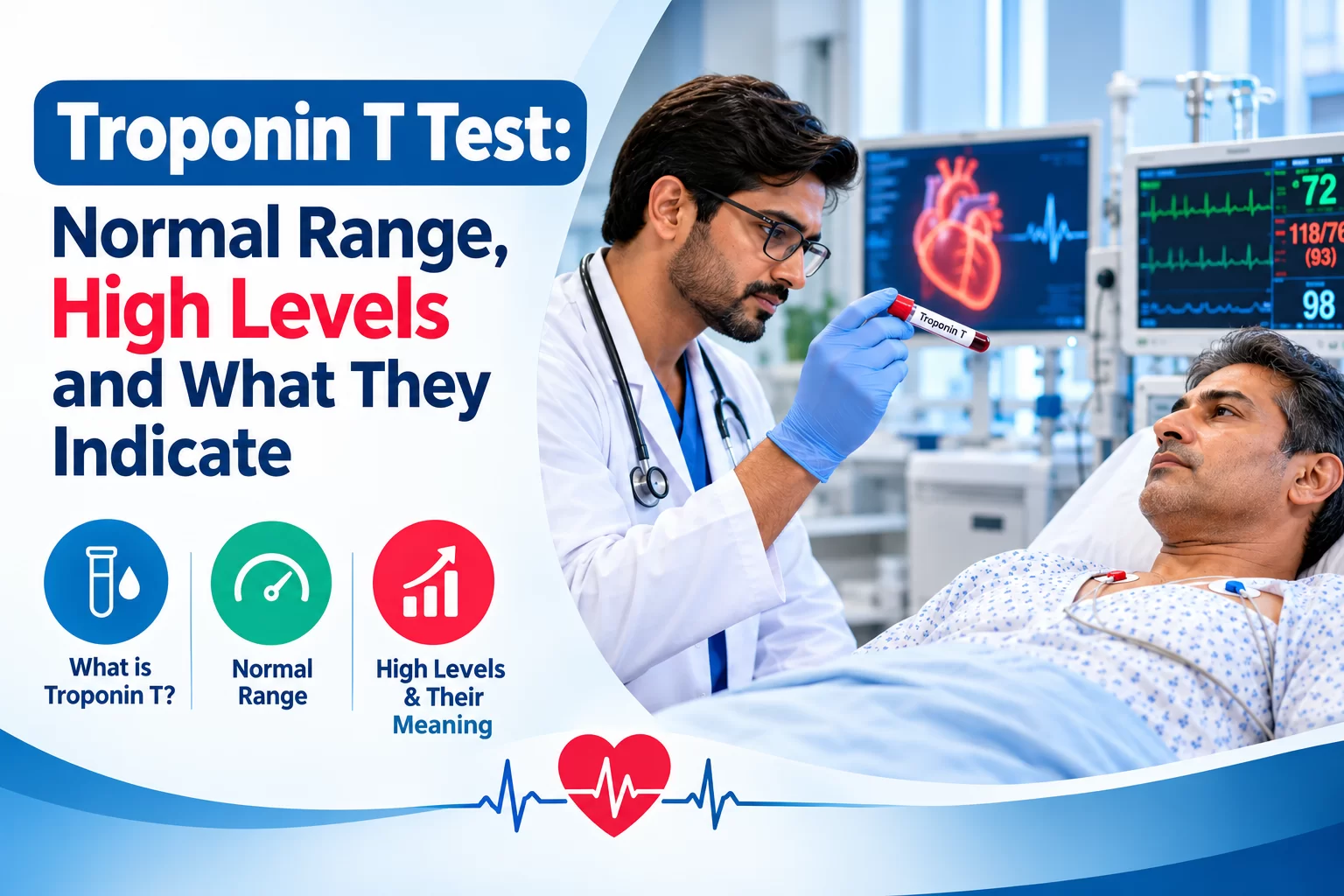
Chest pain and sudden breathlessness are often required urgent evaluation in any clinical setting for detecting heart muscle injury. Among the blood tests that help doctors confirm or rule out heart muscle injury, one protein marker has become the most trusted. Found almost exclusively in cardiac muscle, this protein leaks into the bloodstream when heart cells are damaged, offering a highly specific signal of trouble. A troponin T test measures this marker’s level in the blood and occupy sits at the centre of modern cardiac diagnostics. Understanding its normal range, what high values indicate and how doctors use the result supports informed clinical decisions during cardiac evaluation.
What is a Troponin T Test
Troponin T is a protein found inside cardiac muscle cells that plays an important role in muscle contraction. When reduced blood flow or other damage injures heart cells, troponin T at this time released into the bloodstream which can be detected even in a very small amounts by modern immunoassay techniques and thus making this test assay extremely sensitive for cardiac injury.
The Troponin T Test is one of two major troponin assays used clinically alongside with troponin I. Both the marker provides similar superior accuracy, and most hospitals in India use whichever assay are supported by their chosen laboratory platform. High-sensitivity troponin T (hs-TnT), allows better detection of myocardial injury and supporting faster diagnosis in patients presenting with chest pain or other symptoms suggestive of acute coronary syndrome.
When the test is ordered
Doctors recommend this test in several specific clinical situations where heart muscle injury is suspected. The following are the most common reasons seen in cardiology and emergency settings.
- Suspected heart attack, particularly with chest pain lasting more than a few minutes.
- Sudden shortness of breath without a clear cause.
- Chest discomfort accompanied by pain radiating to the jaw, arm, neck or back.
- Monitoring patient after a confirmed heart attack to track recovery or detect a recurrent event.
- Investigating myocarditis, an inflammation of the heart muscle.
- Assessing cardiac stress in critical illness, sepsis or pulmonary embolism.
- Preoperative cardiac risk assessment in high-risk patients before major surgery. The Troponin T Test is usually interpreted alongside an electrocardiogram (ECG), symptoms, medical history, and physical examination findings. In suspected heart attack, clinicians often draw serial samples over several hours to track how levels change, which helps confirm the diagnosis.
Normal reference range
Lupin Diagnostics reports a single reference range for high-ensitivity troponin T on its cardiac marker report.
| Parameter | Reference range |
| High-sensitivity troponin T | Less than 14 ng/L |
A value within this range makes significant cardiac injury unlikely at the time of testing. In acute settings, serial sampling is often used because changes between readings carry more clinical weight than a single value. Interpretation should always be done by a qualified medical professional.
What high levels indicate
8A raised troponin T level signals cardiac injury but does not identify the exact underlying cause on its own. Doctors interpret the result alongside symptoms, electrocardiogram (ECG) findings, medical history, and other investigations before reaching a diagnosis. The most common causes of a raised reading include:
- Acute myocardial infarction (heart attack), the most frequent reason for a marked rise.
- Myocarditis, an inflammation of the heart muscle that may result from viral infections, autoimmune disorders, or other inflammatory conditions.
- Heart failure, where ongoing strain and injury to the heart muscle can increase troponin concentrations.
- Pulmonary embolism, when a clot in the lungs strains on the right side of the heart.
- Cardiac contusion or direct injury to the heart following chest trauma.
- Severe infection, sepsis or critical illness which can lead to secondary cardiac injury.
- Chronic kidney disease, where mildly elevated troponin levels may be present even in the absence of an acute cardiac event.
Importantly, not every raised reading signifies a heart attack. Clinical context and trend over time are crucial. For example, a single mildly elevated result in a stable patient may have a very different significance from a rapidly rising troponin level in someone experiencing chest pain., which is why doctors often advice repeat sampling.
Troponin T compared with CK-MB
Troponin T has largely replaced CK-MB as the main cardiac biomarker because it is significantly more specific to heart muscle. CK-MB on the contrary, can rise with skeletal muscle injury, creating interpretation challenges. However, CK-MB is still useful for detecting reinfarction because it returns to baseline faster than troponin. Many hospitals use both markers in acute cardiac workups to provide a fuller picture of injury timing and extent.
Choosing a reliable laboratory for your troponin T test
Accurate Troponin T results depend on timely sample processing, properly calibrated analysers, quality control procedures, and standardised reporting practices. Even small timing or technique issues can affect clinical decisions in cardiac emergencies. Lupin Diagnostics offers troponin T, CK-MB and broader cardiac panels across India through its National Accreditation Board for Testing and Calibration Laboratories (NABL) accredited labs, with free home sample collection available in major cities for non-urgent testing.
The bottom line
The Troponin T Test is one of the most sensitive and specific laboratory tests available for detecting heart muscle injury. It plays a central role in diagnosing heart attacks and in evaluating a range of other cardiac conditions. To book a troponin T test or a broader cardiac workup, visit lupindiagnostics.com or call 7030 300 400.
You may love to read: Health


