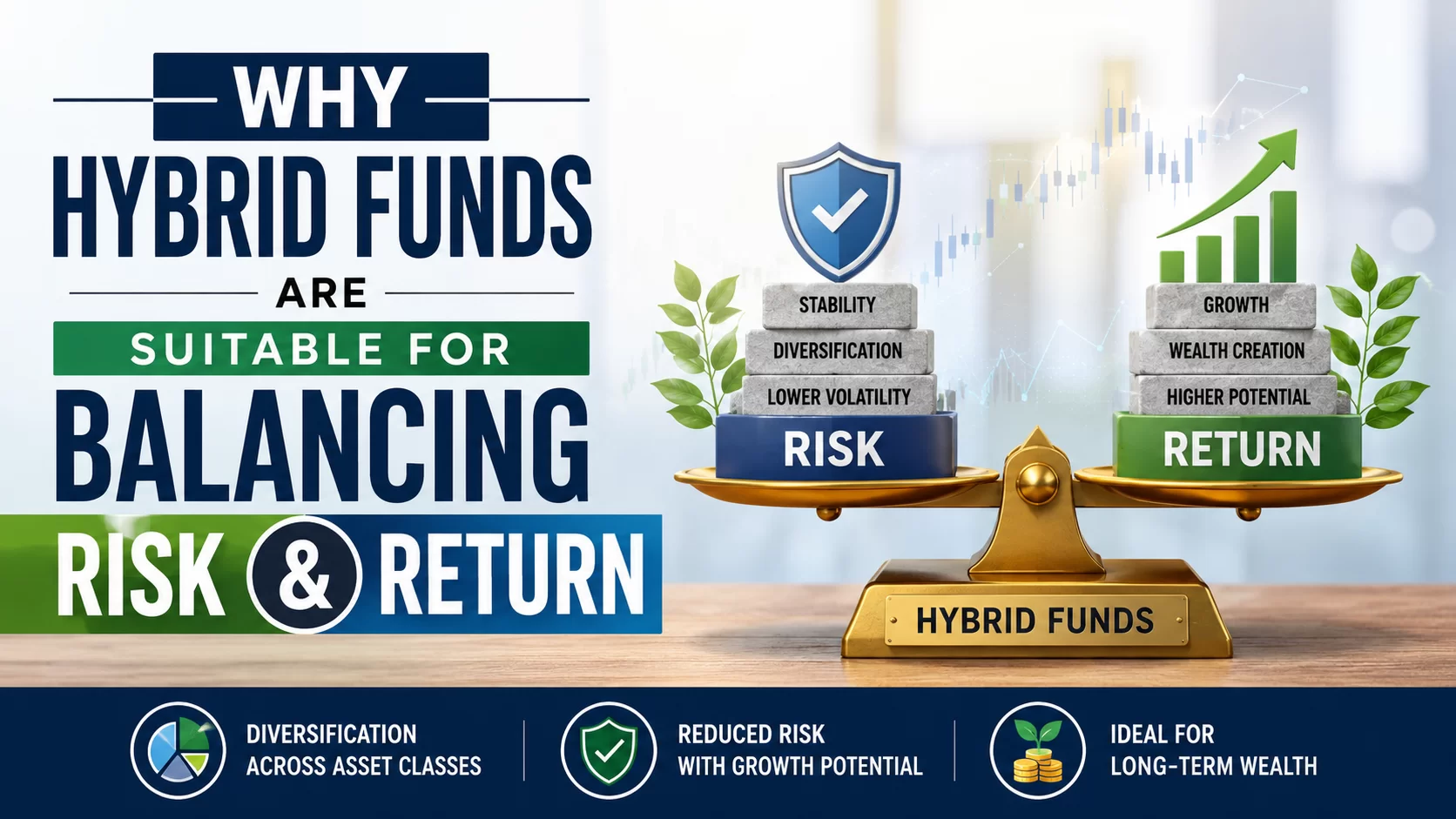
When you begin building your investment portfolio, one question often comes up: should you focus on equity for growth potential, or lean towards debt for relative stability? For many investors, the answer may not lie at either extreme. This is where hybrid funds enter the conversation as a structured way to combine both asset classes within a single investment.
Rather than choosing between growth and stability, hybrid funds aim to blend the two in varying proportions, depending on the fund category and strategy.
What Are Hybrid Funds?
Hybrid funds are mutual fund schemes that invest in a mix of equity and debt instruments. The equity portion provides exposure to market-linked growth potential, while the debt portion may help moderate volatility and provide relatively steady income accrual.
The exact allocation between equity and debt differs across categories. Some schemes maintain a higher equity exposure, while others tilt more towards debt. This asset mix is clearly defined in the scheme documents, allowing investors to understand the intended risk profile before investing.
In simple terms, hybrid funds are designed to offer diversification across asset classes through a single product.
Why Asset Allocation Matters
Asset allocation plays a central role in determining how a portfolio behaves during different market conditions. Equity markets may experience periods of sharp movement, both upward and downward. Debt instruments, although not risk free, are generally influenced by interest rates and credit quality rather than corporate earnings and market sentiment.
By combining these two asset classes, hybrid funds attempt to create a more balanced risk-return profile. The equity component contributes to potential capital appreciation, while the debt allocation may help cushion short-term market fluctuations.
It is important to note that this structure does not eliminate risk. Since hybrid funds are market linked, returns are not guaranteed and may vary depending on asset allocation, market movements, and fund management decisions.
Types of Hybrid Funds
To choose wisely, it helps to understand how different hybrid fund categories are structured and what role each one is designed to play in a portfolio:
Conservative Hybrid Funds
These funds allocate 75% to 90% to debt and 10% to 25% to equity, which may suit investors seeking relatively lower volatility with limited equity exposure.
Balanced Hybrid Funds
These funds allocate 40% to 60% each to equity and debt, aiming to provide a blend of growth potential and relative stability within one scheme.
Aggressive Hybrid Funds
These funds invest 65% to 80% in equity and the remainder in debt, which may appeal to investors comfortable with moderate market-linked fluctuations in pursuit of higher long-term growth potential.
Dynamic Asset Allocation or Balanced Advantage Funds
These funds do not follow a fixed allocation and instead adjust equity and debt exposure based on internal models and market conditions, aiming to manage risk across different market phases.
Multi Asset Allocation Funds
These schemes invest in at least three asset classes such as equity, debt, and commodities, with a minimum allocation to each, offering broader diversification within a single fund.
Equity Savings Funds
These funds combine equity, arbitrage strategies, and debt instruments, typically maintaining a significant equity allocation while aiming to moderate volatility through hedging strategies.
How Hybrid Funds May Fit Into a Portfolio
For investors who find it difficult to actively rebalance between equity and debt, Hybrid funds offer diversification across asset classes within a single scheme. Instead of investing ₹5,00,000 separately across multiple schemes and tracking allocation shifts, a hybrid structure combines both asset classes under professional management.
This approach may reduce the need for frequent manual rebalancing. However, it is still important to periodically review your overall portfolio to ensure that it aligns with your evolving financial objectives.
Hybrid funds are often explored for medium to long-term goals, typically 3 years or more, where some exposure to growth assets is desired but with an added layer of debt allocation to moderate overall volatility.
Who May Consider Hybrid Funds?
Hybrid funds may be considered by investors who:
- Prefer a diversified approach across equity and debt in one scheme
- Have a medium to long-term investment horizon
- Seek a balance between growth potential and relative stability
- Are not comfortable allocating entirely to equity
At the same time, they may not be suitable for investors seeking guaranteed income or those with very short investment horizons.
Conclusion
Hybrid funds offer a structured way to combine equity and debt exposure within a single portfolio. They aim to balance growth potential with relative stability, though they remain subject to market risks and do not guarantee returns. By understanding the allocation strategy, risk profile, and your own financial goals, you can decide whether this blended approach aligns with your broader investment plan.
Mutual Fund investments are subject to market risks, read all scheme related documents carefully.
This document should not be treated as endorsement of the views/opinions or as investment advice. This document should not be construed as a research report or a recommendation to buy or sell any security. This document is for information purpose only and should not be construed as a promise on minimum returns or safeguard of capital. This document alone is not sufficient and should not be used for the development or implementation of an investment strategy. The recipient should note and understand that the information provided above may not contain all the material aspects relevant for making an investment decision. Investors are advised to consult their own investment advisor before making any investment decision in light of their risk appetite, investment goals and horizon. This information is subject to change without any prior notice. The content herein has been prepared on the basis of publicly available information believed to be reliable. However, Bajaj Finserv Asset Management Limited does not guarantee the accuracy of such information, assure its completeness or warrant such information will not be changed. The tax information (if any) in this article is based on prevailing laws at the time of publishing the article and is subject to change. Please consult a tax professional or refer to the latest regulations for up-to-date information.